Integrated Plot Management Innovation to Enhance the Community Economy with a Safe Vegetable Business Model
Abstract
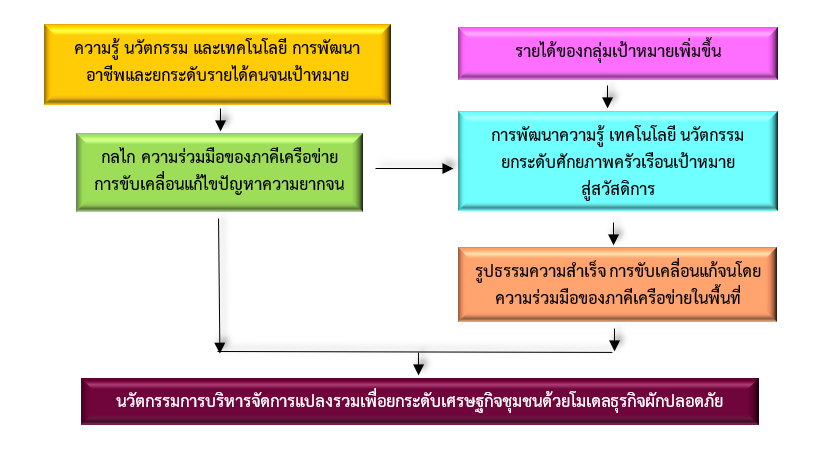
The objectives of this research are 1. develop a poverty alleviation model using appropriate innovation and technology for career development and income enhancement for the target poor, aligned with the local context and target groups based on livelihood capital analysis and access to opportunities for social status enhancement; 2. develop knowledge, technology, and innovation to be utilized to enhance the potential of the target poor to enter welfare; and 3. establish concrete success in driving the district poverty alleviation initiative through the cooperation of local network partners using participatory action research. The primary target group was 1,445 poor households. The secondary target group was 100 local agencies and network partners, selected through purposive sampling. The research areas were the Namon and Kuchinarai Districts in Kalasin Province. The results showed that 1. the poverty alleviation model has been developed into three models according to the potential of poor households: 1) career development for potential households, 2) career development combined with relief, and 3) relief for households lacking potential for career development, which develops careers and raises income. Moreover, 2. Appropriate knowledge, technology, and innovation in three income - generating activities, namely integrated mushroom production, and 3. concrete success in driving the district to alleviate poverty. This is due to the creation of a cooperation mechanism of spatial network partners. Clear strategy, pushing the plan into the local area and creating a district - level fund to help target households.
Downloads
Article Details
How to Cite
Section
Research Articles
Copyright & License
Copyright (c) 2025 Arts and Culture Journal of the Lower Moon River

This work is licensed under a Creative Commons Attribution-NonCommercial-NoDerivatives 4.0 International License.
All articles published open access under the CC BY-NC-ND 4.0 license will be immediately and permanently free for everyone to read, download, copy, distribute, print, search, or link to articles free of charge. Use of the articles is permitted for non-commercial purposes only and without modifications. Access does not require prior permission from the publisher or the author, provided that the original publication is appropriately and adequately cited.




References
กรมส่งเสริมการเกษตร. (2558). การดำเนินงานการส่งเสริมเกษตรในรูปแบบแปลงใหญ่ ปีงบประมาณ 2558. http://www.agriinfo.doae.go.th/year58/definition/large_plot.pdf.
กระทรวงเกษตรและสหกรณ์. (2560). ยุทธศาสตร์เกษตรและสหกรณ์ ระยะ 20 ปี (พ.ศ.2560 - 2579). สำนักงานเศรษฐกิจการเกษตร.
จิระพันธ์ ห้วยแสน, พัฒนา พึ่งพันธุ์, สุพรรณ สุดสนธิ์, วิชยุทธ จันทะรี, ปิยนันท์ ชมนาวัง, พิมพ์ลิขิต แก้วหานาม, กตัญญู แก้วหานาม, อรรถพงษ์ ศิริสุวรรณ, จริยา อินทนิล, อาริยา ป้องศิริ, สิรินดา กมลเขต, ทรงกรด พิมพิศาล, นพคุณ ทองมวล, และ อำภาศรี พ่อค้า. (2566). การแก้ไขปัญหาความยากจนเชิงพื้นที่แบบร่วมมือด้วยนวัตกรรมและการขับเคลื่อนระบบข้อมูลในจังหวัดกาฬสินธุ์. รายงานการวิจัย. สำนักงานสภานโยบายการอุดมศึกษา วิทยาศาสตร์ วิจัยและนวัตกรรมแห่งชาติ.
ชมพูนุท ศรีพงษ์. (2566). การพัฒนาต้นแบบวิสาหกิจชุมชนผลิตสินค้าเกษตรแปรรูปในสามจังหวัดชายแดนใต้ตามโมเดลการจัดการธุรกิจ. รายงานการวิจัย. มหาวิทยาลัยราชภัฏยะลา.
นิตยา เคหะบาล, ธวัชชัย เคหะบาล, นฤชิต แสนปากดี, อภิรดี ดอนอ่อนเบ้า, อารยา ลาน้ำเที่ยง, ธีรนันท์ ขันตี, และ เบญจมาศ ชุมตรีนอก. (2566). การพัฒนารูปแบบการผลิตผักปลอดภัยแปลงรวมเพื่อแก้ไขปัญหาความยากจนอําเภอนามน จังหวัดกาฬสินธุ์. วารสารการบริหารปกครอง, 12(2), 69 - 87. https://doi.org/10.14456/gjl.2023.15.
แผนพัฒนาเศรษฐกิจและสังคมแห่งชาติ ฉบับที่ 13 (พ.ศ. 2566 - 2570) (2565, 1 พฤศจิกายน). ราชกิจจานุเบกษา. เล่ม 139 ตอนพิเศษ 258 ง, 1 - 143.
พระสุธีวชิรคุณ (ณัฐพงศ์ ยโส). (2567). การพัฒนานวัตกรรมเพื่อการแก้ไขปัญหาความยากจนในชุมชนเมือง. วารสารนวัตกรรมสังคมศาสตร์, 1(6), 54 - 63. https://doi.org/10.14456/jssi.2024.30.
พิมพ์ลิขิต แก้วหานาม, จิระพันธ์ ห้วยแสน, อรรถพงษ์ ศิริสุวรรณ, กตัญญู แก้วหานาม, สิรินดา กมลเขต, จริยา อินทนิล, อาริยา ป้องศิริ, นิตยา เคหะบาล, และ อภิรดี ดอนอ่อนเบ้า. (2564). กลไกความร่วมมือเชิงพื้นที่เพื่อแก้ไขปัญหาความยากจน จังหวัดกาฬสินธุ์. วารสารการบริหารปกครอง, 10(2), 257 - 288. https://doi.org/10.14456/gjl.2021.32.
ยุทธนา กาเด็ม, ซูลฟีกอร์ มาโซ, สุพัตรา รุ่งรัตน์, วันฮายาตี อุเซ็งลานง, ทรงจรรย์ แสงอรุณ, และ อรัญญา ชื่นจิต. (2568). นวัตกรรมการขับเคลื่อนงานแก้ไขปัญหาความ ยากจนด้วยกระบวนการมีส่วนร่วมที่สอดคล้องกับบริบทครัวเรือนเป้าหมายแบบบูรณาการ. วารสารสังคมศาสตร์และวัฒนธรรม, 9(1), 313 - 327
รภัสสรณ์ คงธนจารุอนันต์ และ อารีย์ เชื้อเมืองพาน. (2564). ความเข้มแข็งของกลุ่มเกษตรกรระบบเกษตรนาแปลงใหญ่ในจังหวัดเชียงราย. วารสารวิจัยและส่งเสริมวิชาการเกษตร, 38(3), 182 - 193.
สำนักงานจังหวัดกาฬสินธุ์. (2566). แผนพัฒนาจังหวัดกาฬสินธุ์ พ.ศ. 2566 - 2570. กลุ่มงานยุทธศาสตร์และข้อมูลเพื่อการพัฒนาจังหวัดกาฬสินธุ์.
สำนักงานสภาพัฒนาการเศรษฐกิจและสังคมแห่งชาติ. (2566). รายงานวิเคราะห์สถานการณ์ความยากจนและความเหลื่อมล้ำในประเทศไทย. สำนักนายกรัฐมนตรี.
สำนักงานสภาพัฒนาการเศรษฐกิจและสังคมแห่งชาติ. (2568). ภาพรวมคนจนเป้าหมายในปี 2568 ประเทศไทย. สำนักงานนายกรัฐมนตรี. https://www.tpmap.in.th.
Ansell, C., & Gash, A. (2008). Collaborative Governance in Theory and Practice. Journal of Public Administration Research and Theory, 18(4), 543 - 571. https://doi.org/10.1093/jopart/mum032.
Bryson, J. M., Crosby, B. C., & Stone, M. M. (2006). The Design and Implementation of Cross-Sector Collaborations : Propositions from the Literature. Public Administration Review, 66(s1), 44 - 55. https://doi.org/10.1111/j.1540-6210.2006.00665.x.
Emerson, K., & Nabatchi, T. (2015). Collaborative Governance Regimes. Georgetown University Press.
Hossain, M. Z., & Rahman, M. M. (2021). Climate Change Vulnerability and Resilience of Urban Poor in Khulna, Bangladesh : The Role of Asset-based Community Development Approach. International Journal of Urban Sustainable Development, 13(2), 131 - 147. https://doi.org/10.1080/19463138.2020.1828891.
Prahalad, C. K. (2005). The Fortune at the Bottom of the Pyramid (3rd ed.). Prentice Hall.
