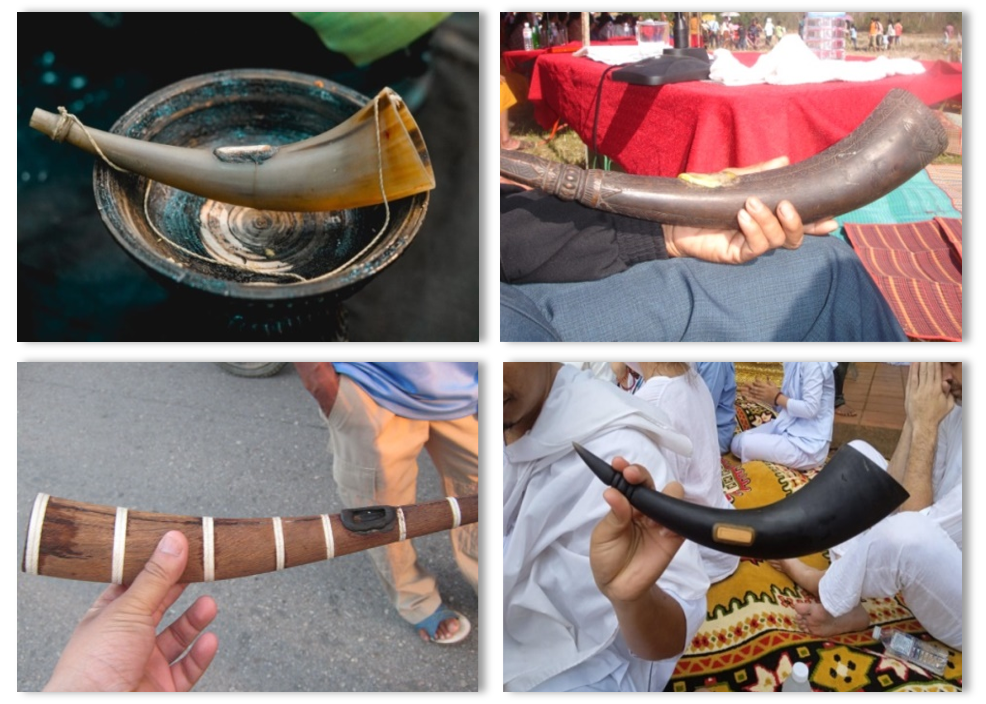
Sanai : The Ethnomusicological Identity of Mekong River Basin Ethnic Groups and the Innovation of Folk Performance
Abstract
This research employs a qualitative methodology rooted in ethnomusicological fieldwork and descriptive analysis. The primary objectives are: 1. to investigate the shared cultural identity of the Sanai among ethnic groups in the Mekong River Basin; 2. to analyze the musical identity of the Sanai; and 3. to create musical performance innovations centered on the instrument. The study focuses on three key geographical areas: Southern Northeast Thailand, Southern Laos, and Northern Cambodia. The findings reveal that the Sanai serves as a shared cultural identity linked to the histories of various ethnic groups in the Mekong region, including the Kuy (Suai), Khmer, Lao, Yer, Bru, Katu, and Mnong, and known by various regional names such as Sanai, Sanong, Saneng, and Tar-lo. The instrument is traditionally crafted from buffalo horn or ivory. The Sanai holds a significant cultural connection to elephant-roundup rituals and the spiritual belief in the sacredness of buffalo sounds. It is utilized both as a sacred object in high-order rituals and as a musical instrument for entertainment. Regarding musical identity, the Sanai is a free-reed aerophone with a single reed, typically made of bamboo, inserted into the body of the horn. Pitch modulation is achieved through three distinct levels by manipulating the openings at the tip and the bell of the horn. Furthermore, this research successfully innovated the instrument by calibrating its pitches to the Western chromatic scale—specifically C, D, and E. Traditional melodies were transcribed into Thai and Western notation systems, facilitating the creation of a large-scale folk ensemble performance involving 200 Sanai players.
Downloads
Article Details
How to Cite
Section
Research Articles
Copyright & License
Copyright (c) 2025 Arts and Culture Journal of the Lower Moon River

This work is licensed under a Creative Commons Attribution-NonCommercial-NoDerivatives 4.0 International License.
All articles published open access under the CC BY-NC-ND 4.0 license will be immediately and permanently free for everyone to read, download, copy, distribute, print, search, or link to articles free of charge. Use of the articles is permitted for non-commercial purposes only and without modifications. Access does not require prior permission from the publisher or the author, provided that the original publication is appropriately and adequately cited.




References
เชิดศักดิ์ ฉายถวิล. (2554). สะไนง์ เครื่องดนตรีชาวเยอ. ศรีสะเกษการพิมพ์.
เชิดศักดิ์ ฉายถวิล. (2567ก). ลักษณะเครื่องเป่าสะไนที่พบในพื้นที่ประเทศลุ่มน้ำโขง [ภาพถ่าย]. การจัดเก็บส่วนบุคคล.
เชิดศักดิ์ ฉายถวิล. (2567ข). ลักษณะโครงสร้างลิ้นแคนกับลิ้นสะไน [ไดอะแกรม]. การจัดเก็บส่วนบุคคล.
เชิดศักดิ์ ฉายถวิล. (2567ค). การบรรเลงสะไนของกลุ่มชาติพันธุ์ลุ่มน้ำโขงในพื้นที่อีสานใต้ ลาวใต้ และประเทศกัมพูชา [ภาพถ่าย]. การจัดเก็บส่วนบุคคล.
เชิดศักดิ์ ฉายถวิล. (2567ง). การพัฒนาโครงสร้างสะไนและการสร้างสรรค์นวัตกรรมการแสดงดนตรีชาติพันธุ์สะไน [ภาพถ่าย]. การจัดเก็บส่วนบุคคล.
เชิดศักดิ์ ฉายถวิล. (2567จ). การพัฒนานวัตกรรมดนตรีจากท่วงทำนองและเสียงเป่าดั่งเดิมให้เป็นโน้ตดนตรี [ภาพถ่าย]. การจัดเก็บส่วนบุคคล.
ณรงค์ชัย ปิฎกรัชต์. (2557). สารานุกรมเพลงไทย. สำนักพิมพ์มหาวิทยาลัยมหิดล.
นิยพรรณ (ผลวัฒนะ) วรรณศิริ. (2550). มานุษยวิทยาสังคมและวัฒนธรรม. เอ็กซเปอร์เน็ท.
ปราโมทย์ ด่านประดิษฐ์. (2549). ข้อควรคำนึงและขอบข่ายของการศึกษาดนตรี. วารสารศิลปะและวัฒนธรรมลุ่มแม่น้ำมูล, 1(ปีการศึกษา 2549), 59 - 68. https://doi.org/10.14456/acj.2006.7.
พิพัฒน์พงศ์ มาศิริ. (2559). แนวคิดในการศึกษาอัตลักษณ์ทางดนตรี. MFU Connexion : Journal of Humanities and Social Sciences, 5(1), 146 - 165.
ศักดิ์ชัย หิรัญรักษ์. (2535). โครงสร้างทางกายภาพของเครื่องลมไทย และ การจัดแบ่งหมวดหมู่ [วิทยานิพนธ์ปริญญามหาบัณฑิตไม่ได้ตีพิมพ์]. มหาวิทยาลัยมหิดล.
สำนักวิชาการและมาตรฐานการศึกษา. (2562). ประวัติศาสตร์ร่วมรากอุษาคเนย์ : สานเสวนาเพื่อความเข้าใจระหว่างวัฒนธรรมและสันติวัฒนธรรม. สำนักงานคณะกรรมการการศึกษาขั้นพื้นฐาน.
สุจิตต์ วงษ์เทศ. (2532). ร้องรำทำเพลง : ดนตรีและนาฏศิลป์ชาวสยาม. มติชน.
สุรพล เนสุสินธุ์. (2555). แคนของกลุ่มชาติพันธ์ไตในภูมิภาคลุ่มน้ำโขง : แหล่งกำเนิด การแพร่กระจาย และ แนวทางการพัฒนา [วิทยานิพนธ์ปริญญาดุษฎีบัณฑิตไม่ได้ตีพิมพ์]. มหาวิทยาลัยมหาสารคาม.
อภิญญา เฟื่องฟูสกุล. (2546). อัตลักษณ์ : การทบทวนทฤษฎีและกรอบแนวคิด. สำนักงานคณะกรรมการวิจัยแห่งชาติ.
อัครพล ชูเชิด. (2543). การศึกษาเครื่องดนตรีสไนของเมืองคง จังหวัดศรีสะเกษ [วิทยานิพนธ์ปริญญามหาบัณฑิต, จุฬาลงกรณ์มหาวิทยาลัย]. Chulalongkorn University Intellectual Repository. https://digiverse.chula.ac.th/Info/item/dc:50839.
อัญชลี กิ๊บบินส์. (2561). คัมภีร์พิณ ดนตรีแห่งลมปราณและจิตวิญญาณ. วารสารข่วงผญา, 13, 68 - 98.
