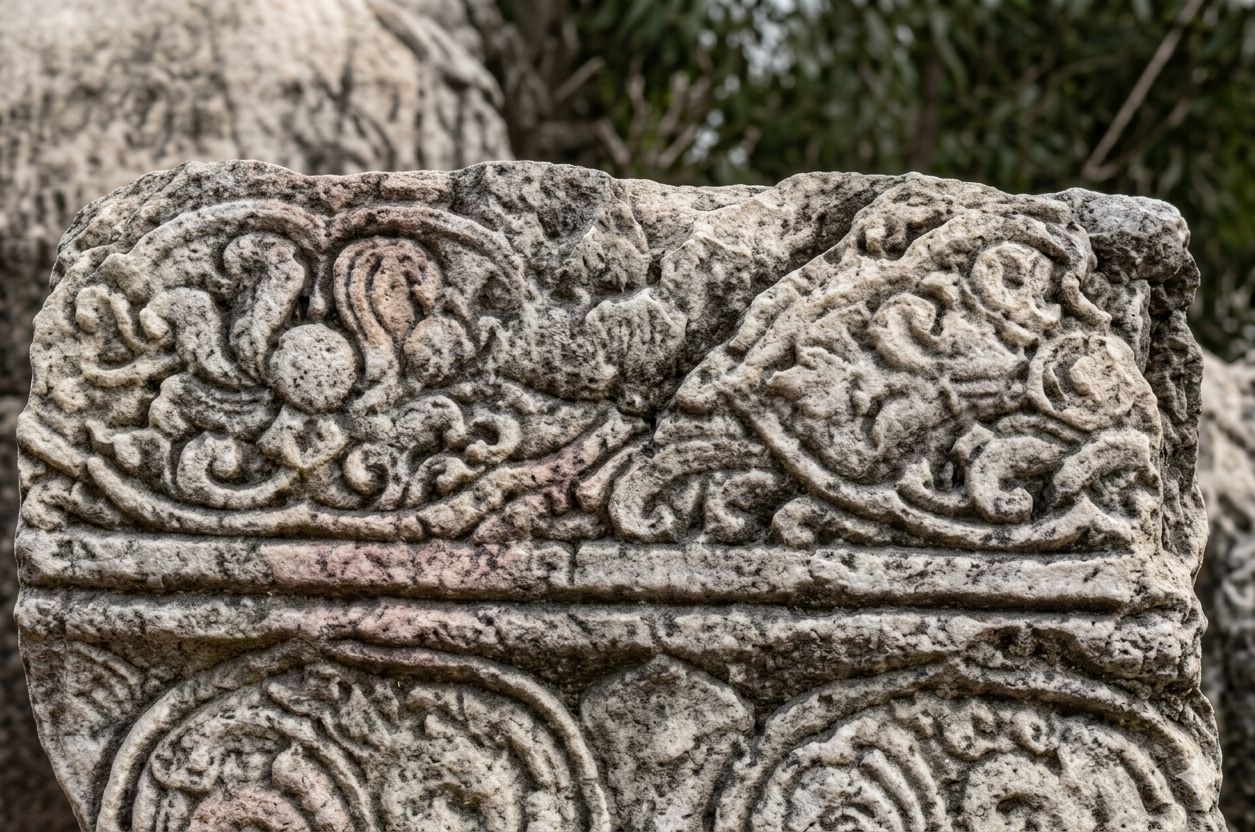
A Comparative Study of Patterns and Meanings of Universal Islamic Art and Ayutthaya Period Art in Phra Nakhon Si Ayutthaya Province
Abstract
This article aims to comparatively study the patterns and meanings of universal Islamic art and Ayutthaya-period artworks in Phra Nakhon Si Ayutthaya Province, aiming to establish a body of knowledge for pattern creation. This qualitative research employed in-depth interviews with a purposively selected group of three experts in Islamic art patterns. The research instrument was a qualitative questionnaire, and data were analyzed using statistical means ( and standard deviations (S.D.) to summarize
the findings. The study analyzed the comparative similarity of 9 samples of Islamic art patterns discovered in Phra Nakhon Si Ayutthaya Province. The similarity analysis ranked the items as follows: 1) A gold ring inscribed with interlaced Arabic letters Lam and Alif (x̅ = 3.69, S.D. = 0.71); 2) Lotus motifs (x̅ = 3.43, S.D. = 0.17); 3) Stucco decorative motifs featuring three petals or a three-pointed leaf pattern (x̅ = 3.37, S.D. = 0.27); 4) Interlaced patterns or the endless knot; 5) Window trellis motifs of the minor Viharas at Wat Phra Si Sanphet, Phra Nakhon Si Ayutthaya; 6) Components of gold ornaments, gold chest pendants, and neck ornament fragments; 7) Motifs on fragments of gold and gemstone jewelry; 8) Patterns on coins discovered in the crypt of the main Prang at Wat Ratchaburana; and 9) Lotus motifs reflecting the influence of Islamic art during the Ayutthaya period.
The overall mean similarity of the 9 patterns was at a moderate level (x̅ = 3.25, S.D. = 0.19). Furthermore, these findings can be developed into a comprehensive body of knowledge regarding various pattern formats and structural designs for future related research.
Downloads
Article Details
How to Cite
Section
Research Articles
Copyright & License
Copyright (c) 2026 Arts and Culture Journal of the Lower Moon River

This work is licensed under a Creative Commons Attribution-NonCommercial-NoDerivatives 4.0 International License.
All articles published open access under the CC BY-NC-ND 4.0 license will be immediately and permanently free for everyone to read, download, copy, distribute, print, search, or link to articles free of charge. Use of the articles is permitted for non-commercial purposes only and without modifications. Access does not require prior permission from the publisher or the author, provided that the original publication is appropriately and adequately cited.




References
เจนจิรา เบญจพงศ์. (2549). ลวดลายประดับแบบอิสลามในศิลปะไทย (พุทธศตวรรษที่ 21-23) [วิทยานิพนธ์ปริญญามหาบัณฑิต, มหาวิทยาลัยศิลปากร]. Sure. https://sure.su.ac.th/xmlui/handle/123456789/1526.
จิดาพร แสงนิล. (2548). การศึกษาชุมชนมุสลิมในจังหวัดพระนครศรีอยุธยาในสมัยอยุธยา (พุทธศตวรรษที่ 19-23) [วิทยานิพนธ์ปริญญามหาบัณฑิต, มหาวิทยาลัยศิลปากร]. Sure. https://sure.su.ac.th/xmlui/handle/123456789/1333.
ตรงใจ หุตางกูร. (2563). วันที่ 4 มีนาคม พ.ศ. 1893 เป็นวันสถาปนากรุงศรีอยุธยาจริงหรือ?. ศูนย์มานุษยวิทยาสิรินธร. https://www.sac.or.th/portal/th/article/detail/108.
วรพจน์ ไวยเวทา. (2561). ทฤษฏีเชิงช่างศิลปะอิสลามที่ให้อิทธิพลกับลวดลายประดับสมัยอยุธยา. [วิทยานิพนธ์ปริญญามหาบัณฑิต, จุฬาลงกรณ์มหาวิทยาลัย]. Chula Digital Collection. https://digital.car.chula.ac.th/chulaetd/2928/.
วรวิทย์ สินธุรหัส. (2555). รูปแบบลวดลายเครื่องประดับทองคำจากกรุปรางค์ประธานวัดราชบูรณะ พระนครศรีอยุธยา [วิทยานิพนธ์ปริญญามหาบัณฑิต, มหาวิทยาลัยศิลปากร]. Sure. http://www.thapra.lib.su.ac.th/thesis/showthesis_th.asp?id=0000008024.
ศูนย์นวัตกรรมการออกแบบ อุทยานวิทยาศาสตร์ มหาวิทยาลัยสงขลานครินทร์. (2566). ศิลปะอิสลาม สุนทรียะ เสน่ห์ และแรงบันดาลใจ. Heyzine. https://heyzine.com/flip-book/5c69893c6f.html
สุจิตต์ วงษ์เทศ. (2567). อยุธยามาจากไหน? (พิมพ์ครั้งที่ 2). หจก. เรือนแก้วการพิมพ์.
เสาวภาคย์ สุวรรณเรือง. (2560). ลวดลายศิลปะอิสลามในงานศิลปกรรมวัดราชบูรณะ จังหวัดพระนครศรีอยุธยา. [วิทยานิพนธ์ปริญญามหาบัณฑิต, มหาวิทยาลัยศิลปากร]. Sure. https://sure.su.ac.th/xmlui/handle/123456789/26163?attempt=2&.
อาดิศร์ อิดรีส รักษมณี. (2557). มัสยิดในกรุงเทพฯ (พิมพ์ครั้งที่ 1). สำนักพิมพ์มติชน.
Henry, R. (2012). Geometry – The Language of Symmetry in Islamic Art. https://artofislamicpattern.com/resources/educational-posters/.
