Transforming Literacy Education : Experiential Learning Curriculum Design for Reading and Writing in Thai Private Schools within a Local Context
Abstract
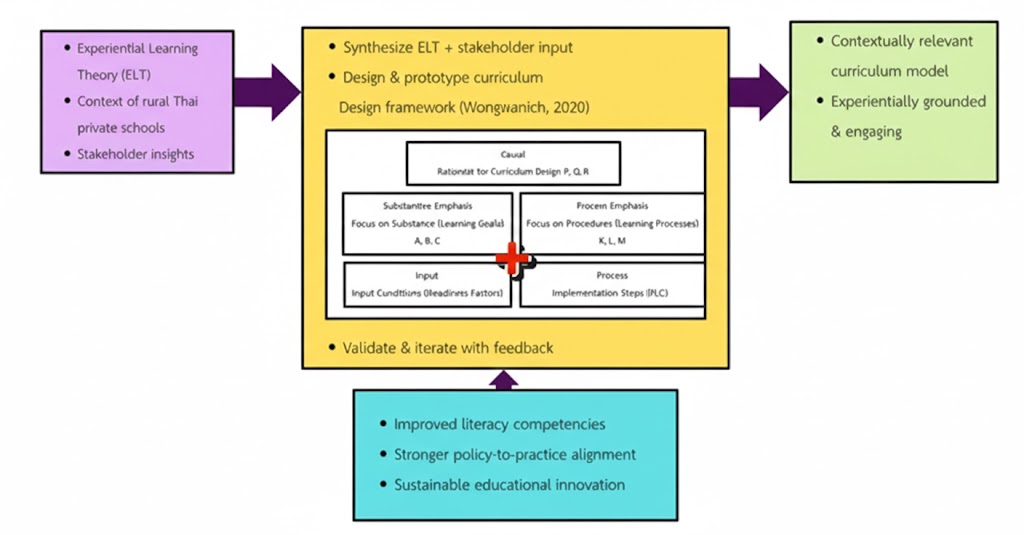
This study aimed to (1) synthesize curriculum design principles for reading and writing literacy based on experiential learning, using a case study of stakeholders in private schools within a local context, and (2) propose curriculum design guidelines to enhance Thai reading and writing competencies among early primary school students. The research adopted a qualitative approach grounded in Kolb’s experiential learning theory and Suwimon Wongwanich’s educational design framework. Participants included 79 individuals across seven stakeholder groups : 30 parents of students in Grades 1-3, 30 students (10 per grade), 4 Thai language teachers, 1 educational officer (coordinating program implementation and ensuring quality standards), and 4 curriculum designers. Data were analyzed to extract design principles categorized into five components : (1) arguments emphasizing experiential learning, technology integration, and positive psychology; (2) substantive emphasis focused on reading fluency, writing ability, and integrated literacy; (3) procedural emphasis based on Kolb’s learning cycle, emotional support, and digital tools; (4) input such as teacher preparation and parental involvement; and (5) processes featuring real-world themes, reflection, and continuous feedback through Professional Learning Community. The proposed prototype curriculum comprises six key elements : arguments and needs, curriculum concepts, goals and vision, a modular structure (60 hours per year per grade), support systems, and curriculum attachments. It is designed to be context-sensitive and responsive to the challenges of private schools. Findings suggest that experiential learning with emotional and technological supports improves literacy education in under-resourced settings, contributing to Thailand's competency-based education reform.
Downloads
Article Details
How to Cite
Section
Research Articles
Copyright & License
Copyright (c) 2026 Arts and Culture Journal of the Lower Moon River

This work is licensed under a Creative Commons Attribution-NonCommercial-NoDerivatives 4.0 International License.
All articles published open access under the CC BY-NC-ND 4.0 license will be immediately and permanently free for everyone to read, download, copy, distribute, print, search, or link to articles free of charge. Use of the articles is permitted for non-commercial purposes only and without modifications. Access does not require prior permission from the publisher or the author, provided that the original publication is appropriately and adequately cited.




References
Abdalla Muhammed, S., Jacob Seni, A., & Renatus Mligo, I. (2022). Parents’ Involvement in Early Childhood Education Curriculum Development : A Case of Kaskazini ‘A’ District in Zanzibar. East African Journal of Education and Social Sciences, 3(5). https://doi.org/10.46606/https://doi.org/10.46606/eajess2022v03i05.0214.
Akçay, S. (2016). The Consistency Among Curriculum, Textbooks and Placement Tests in Terms of Elementary Biology Education in Turkey. Pegem Eğitim Ve Öğretim Dergisi, 4(2), 1 - 24. https://doi.org/10.14527/pegegog.2014.007.
Azevedo, J., Padrão, P., Gregório, M. J., Almeida, C., Moutinho, N., Lien, N., & Barros, R. (2019). A Web-Based Gamification Program to Improve Nutrition Literacy in Families of 3-To 5-Year-Old Children: The Nutriscience Project. Journal of Nutrition Education and Behavior, 51(3), 326 - 334. https://doi.org/10.1016/j.jneb.2018.10.008.
Bao, M. H. (2024). The Study of the Difference in Elementary School Art Education Curriculum Between China and the United States. 1(4). https://doi.org/10.61173/6475f324.
Bunsornchai, R., Yonwilad, W., & Pimsak, A. (2025). EXPERIENTIAL LEARNING-BASED CURRICULUM DESIGN FOR READING AND WRITING COMPETENCY DEVELOPMENT : A STAKEHOLDER PERSPECTIVE ANALYSIS. Journal of Interdisciplinary Social Development, 3(6), 913 - 930.
Desy, A., Nursalam, N., Suharti, S., Mattoliang, L. A., & Baharuddin, B. (2024). Development of Mathematics Teaching Material Based on Experiential Learning Model to Improve Students’ Mathematical Literacy Skills. Itm Web of Conferences, 58, 03003. https://doi.org/10.1051/itmconf/20245803003.
Errasti‐Ibarrondo, B., Jordán, J. A., Díez‐Del‐Corral, M. P., & Arantzamendi, M. (2018). Conducting Phenomenological Research : Rationalizing the Methods and Rigour of the Phenomenology of Practice. Journal of advanced nursing, 74(7), 1723 - 1734. https://doi.org/10.1111/jan.13569.
Furió, D., Juan, M. C., Seguì, I., & Vivó, R. (2014). Mobile Learning vs. Traditional Classroom Lessons : A Comparative Study. Journal of Computer Assisted Learning, 31(3), 189 - 201. https://doi.org/10.1111/jcal.12071.
Hall, M., Goettle, A., Carson, C., Collicott, J., Dietz, K., & Smith, K. (2020). Successful Undergraduate-Level Experiential Learning Projects. 106 - 112. https://doi.org/10.1145/3368308.3415387.
Hayati, R. S. (2020). Pendidikan Lingkungan Berbasis Experiential Learning Untuk Meningkatkan Literasi Lingkungan. Humanika, 20(1), 63 - 82. https://doi.org/10.21831/hum.v20i1.29039.
Hughes, M. T., & Braun, G. (2019). Experiential Learning Experiences to Enhance Preservice Special Educators Literacy Instruction. International Electronic Journal of Elementary Education, 12(1), 93 - 102. https://doi.org/10.26822/iejee.2019155341.
Jantjies, M., Moodley, T., & Maart, R. (2018). Experiential Learning Through Virtual and Augmented Reality in Higher Education. 42 - 45. https://doi.org/10.1145/3300942.3300956.
Kolb, A. Y., & Kolb, D. A. (2022). Experiential Learning Theory as a Guide for Experiential Educators in Higher Education. Experiential Learning and Teaching in Higher Education. https://doi.org/10.46787/elthe.v1i1.3362.
Li, Y., & Siriphan, C. (2023). Construction of a Sensory Integration Physical Education Model to Improve Basic Motor Skills in Primary Schools. 3(6), 375 - 384. https://doi.org/10.60027/ijsasr.2023.3640.
McKenney, S., & Reeves, T. C. (2012). Conducting educational design research. Routledge.
Malasari, S., & Kurniawati, L. A. (2019, 12 October). Experiential Learning : Exploring Human Literacy of English Language Teaching in Education 4.0. The 1st International Conference on Language and Language Teaching. Faculty of Education and Teacher Training Universitas Tidar. https://doi.org/10.4108/eai.12-10-2019.2292232.
Nandee, S., Intasena, A., & Srimunta, T. (2024). Enhancing Reading Literacy in Thai Grade 2 Students through Active Learning Activities. IJLTER. ORG, 23(8), 414 - 425. https://doi.org/10.26803/ijlter.23.8.21.
Nasongkhla, J., & Sujiva, S. (2023). Enhancing Reading Capability of Young Thai Students with Augmented Reality Technology : Design-Based Research. Contemporary Educational Technology, 15(1), ep403. https://doi.org/10.30935/cedtech/12721.
Nurhikmah, S., Sandy, S., & Erihadiana, M. (2023). Humanistic Curriculum Development Model Typical of Anak Langit Islamic Elementary School (ALIEs) in Bandung, West Java. Fondatia, 7(1), 52 - 64. https://doi.org/10.36088/fondatia.v7i1.2948.
Rietmeijer, C. B., Deves, M., van Esch, S. C., van der Horst, H. E., Blankenstein, A. H., Veen, M., Scheele, F., & Teunissen, P. W. (2021). A Phenomenological Investigation of Patients’ Experiences during Direct Observation in Residency : Busting the Myth of the Fly on the Wall. Advances in Health Sciences Education, 26, 1191 - 1206. https://doi.org/10.1007/s10459-021-10044-z.
Saliao, M. D., & Cajandig, A. J. S. (2025). Integration of Technology in Teaching Mathematics : Assessing the Influence of Digital Pedagogy on Learning Engagement and Achievement among Grade 8 Students. International Journal of Research and Innovation in Social Science. https://dx.doi.org/10.47772/IJRISS.2025.90400320.
Santaló, M. I., Gibbons, S. L., & Naylor, P. J. (2019). Using Food Models to Enhance Sugar Literacy Among Older Adolescents : Evaluation of a Brief Experiential Nutrition Education Intervention. Nutrients, 11(8), 1763. https://doi.org/10.3390/nu11081763.
Sasmoko, Udjaja, Y., Indrianti, Y., Zhong, X. X., & Abu Bakar, A. Y. (2020, 25 August). Experiential Learning Design of E-Learning Website. The 1st Progress in Social Science, Humanities and Education Research Symposium. Universitas Negeri Padang, Indonesia. https://doi.org/10.2991/assehr.k.200824.148.
Staley, A., & Eastcott, D. (1999). Computer-Supported Experiential Learning (Phase One - Staff Development). Research in Learning Technology, 7(1). https://doi.org/10.3402/rlt.v7i1.11239.
Wang, H. (2023). A Study on the Integrated Teaching Model of Core Literacy in College Physical Education and Health Courses Using Multiple Data Fusion. Applied Mathematics and Nonlinear Sciences, 9(1). https://doi.org/10.2478/amns.2023.2.00840.
Wiyani, N. A., Mulyani, N., & Samaeng, W. A. (2023). Principal Raudhatul Athfal's Participatory Behavior Practices in Implementing the Independent Curriculum in Indonesia. Tarbawi Jurnal Keilmuan Manajemen Pendidikan, 9(02), 287 - 296. https://doi.org/10.32678/tarbawi.v9i02.9283.
Wongwanich, S. (2020). Design Research in Education. Chulalongkorn University Printing House.
Zhou, C., Li, H., & Bian, Y. (2020). Identifying the Optimal 3D Display Technology for Hands-on Virtual Experiential Learning : A Comparison Study. IEEE Access, 8, 73791 - 73803. https://doi.org/10.1109/access.2020.2988678.
