
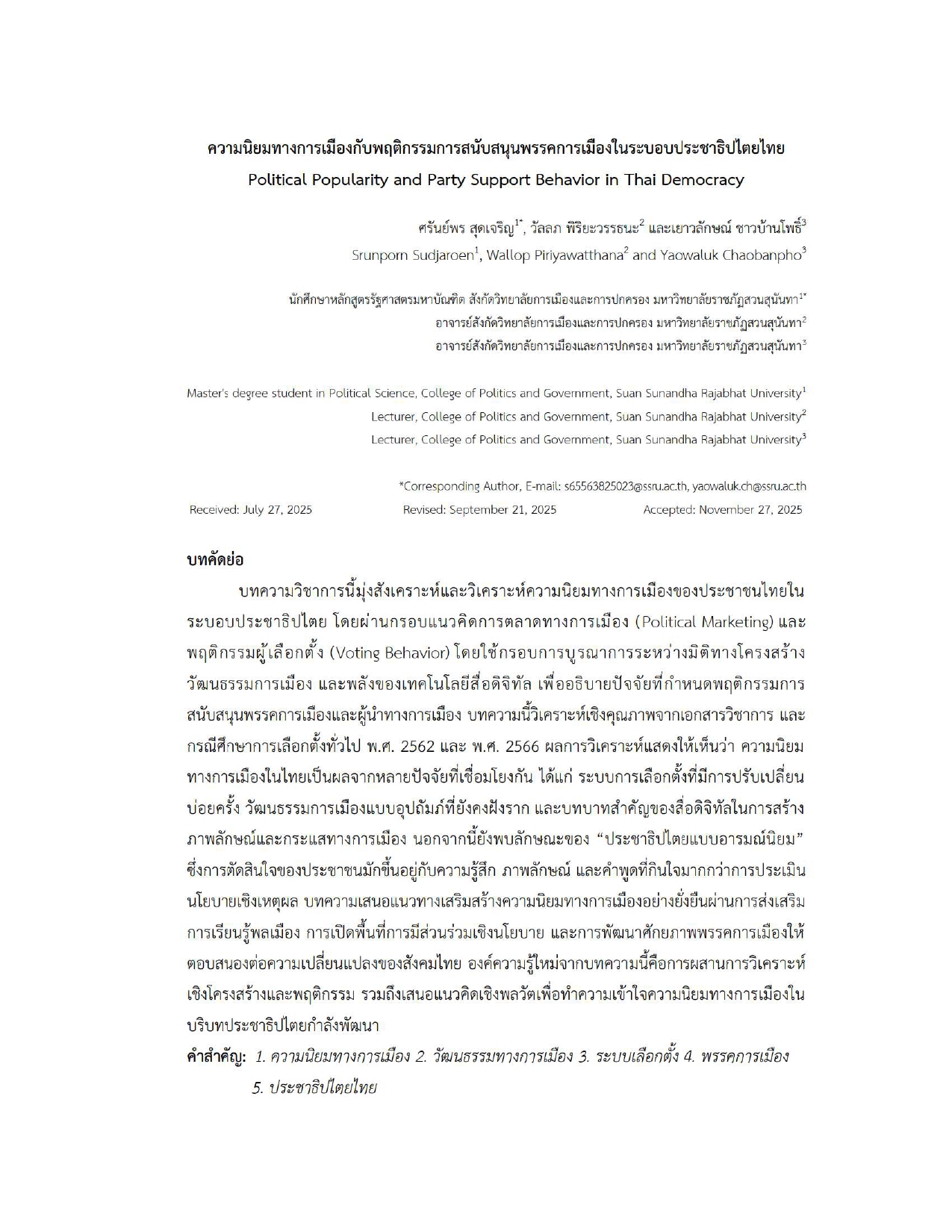
Political Popularity and Party Support Behavior in Thai Democracy
Keywords:
Political popularity , political culture , electoral system , political parties, Thai democracyAbstract
This academic article aims to synthesize and analyze the political popularity of Thai citizens within a democratic framework through the lense of Political Marketing and Voting Behavior theories. It employs an integrative framework that combines structural dimensions, political culture, and the dynamic of digital media technology to explain the factor shaping public support for political parties and leaders. The article adopts a qualitative methodology, drawing upon academic literature and case studies of the 2019 and 2023 general elections in Thailand.
The findings reveal that political popularity in Thailand is shaped by interrelated factors: the frequent change in the electoral system, the persistent entrenchment of patron–client political culture, and the critical role of digital media in constructing political image and mobilizing public sentiment. Moreover, the study reveals the emergence of an “emotional democracy,” in which citizens’ decisions are often driven by sentiment, image, and emotional attachment rather than rational policy evaluation. The article further proposes pathways to foster sustainable political popularity through the promotion of civic education, establishing inclusive policy platforms, and enhancing political parties’ ability to adapt to Thailand’s shifting inclusive policy context. The article’s contribution lies in its integration of structural and behavioral perspectives, offering a dynamic conceptual framework for understanding political popularity in the context of a developing democracy.
References
นภัสวรรณ์ รักษาใจ. (2565). การสื่อสารทางการเมืองผ่าน TikTok เพื่อการต่อต้านรัฐบาลบนโลก ออนไลน์ ช่วงปี 2563-2564 [วิทยานิพนธ์รัฐศาสตรมหาบัณฑิต] จุฬาลงกรณ์มหาวิทยาลัย.
พัชรมน โคตรสุโพธิ์, & กัญจนิวัชร์ หงส์ประภัส. (2567). การเมือง รัฐ และความหลากหลายทางการเมือง. วารสารวิจารณ์นโยบายและสังคมศาสตร์ มหาวิทยาลัยราชภัฏนครปฐม, 15(1), 100–110.
วรรักษ์ โพธิ์ทอง, ถวิลศิริ สอาดศรี, สุภัทริน์ เพ็ชรชิต, และพัชรมน โคตรสุโพธิ์. (2566). การเปรียบเทียบแนวคิด ทางการเมือง การเคลื่อนไหวทางการเมืองและข้อเรียกร้องของนักศึกษาและปัญญาชน: กรณีศึกษาเปรียบเทียบเหตุการณ์ 14 ตุลาคม 2516 และพฤษภาทมิฬ 2535. วารสารวิจารณ์ นโยบายและสังคมศาสตร์ มหาวิทยาลัยราชภัฏนครปฐม, 11(2), 108–120.
วิสุทธิ์ ขันติศิริ. (2564). กลยุทธ์การตลาดทางการเมืองกับพฤติกรรมการตัดสินใจในการลงคะแนนเสียงเลือกตั้ง 24 มีนาคม 2562 [วิทยานิพนธ์นิติศาสตรมหาบัณฑิต] มหาวิทยาลัยธุรกิจบัณฑิตย์.
Baranovskyi, F. (2023). The role of the visual image of a political leader in a democratic society. National Technical University of Ukraine Journal. Political science. Sociology. Law, 40–47. https://doi.org/10.20535/2308-5053.2023.2(58).285597
Boulianne, S. (2018). Twenty years of digital media effects on civic and political participation. Communication Research, 47(7), 947–966. https://doi.org/10.1177/0093650218808186
Boulianne, S., & Theocharis, Y. (2018). Young people, pigital media, and engagement: A meta-analysis of research. Social Science Computer Review, 38(2), 111-127. https://doi.org/10.1177/0894439318814190
Campbell, A., Converse, P., Miller, W., & Stokes, D. (1960). The American voter. Chicago, IL: University of Chicago Press.
Catterberg, G., & Moreno, A. (2006). The individual bases of political trust: Trends in new and established democracies. International Journal of Public Opinion Research, 18, 31-48. https://doi.org/10.1093/IJPOR/EDH081
Chachavalpongpun, P. (2025). Dissent from a distance: Rising political activism of young Thai diasporas. Journal of Current Southeast Asian Affairs, 44(2), 313-337. https://doi.org/10.1177/18681034251336767
Downs, A. (1957). An economic theory of democracy. New York, NY: Harper and Row.
Falkowski, A., & Cwalina, W. (2012). Political marketing: Structural models of advertising influence and voter behavior. Journal of Political Marketing, 11, 26 - 8. https://doi.org/10.1080/15377857.2012.642705
Haider, R. (2025). Navigating the digital political landscape: How social media marketing shapes voter perceptions and political brand equity in the 21st Century. International Journal of Science and Research Archive, 15(1), 1736-1744.
https://doi.org/10.30574/ijsra.2025.15.1.1217
Kanchanawongpaisan, S., Fei, Z., Zeyu, Z., Tee, M., & Lu, L. (2025). Factors influencing political perspectives in a changing society: Case study Bangkok, Thailand. International Journal of Computational and Experimental Science and Engineering, 11(2), 2721-2729. https://doi.org/10.22399/ijcesen.1788
Larsson, T. (2022). Religion, political parties, and Thailand’s 2019 election: Cosmopolitan royalism and its rivals. Modern Asian Studies, 57, 582 - 612. https://doi.org/10.1017/S0026749X22000038
Lees-Marshment, J. (2001). Political marketing and British political parties. Manchester, England: Manchester University Press.
Manek, D., & Fadah, I. (2024). Effectiveness of digital marketing strategies and political brand reinforcement. JEM17: Journal Ekonomi Manajemen, 9(1), 41-56. https://doi.org/10.30996/jem17.v9i1.10942
McAllister, I. (2003). Prime ministers, opposition leaders and government popularity in Australia. Australian Journal of Political Science, 38, 259 - 277. https://doi.org/10.1080/1036114032000092710
Mccargo, D. (2019). Southeast Asia's troubling elections: Democratic demolition in Thailand. Journal of Democracy, 30, 119 - 133. https://doi.org/10.1353/jod.2019.0056
Meesuwan, S. 2016. The effect of Internet use on political participation: Could the Internet increase political participation in Thailand? International Journal of Asia Pacific Studies 12(2), 57–82. DOI: 10.21315/ijaps2016. 12.2.3
Michels, A. (2011). Innovations in democratic governance: how does citizen participation contribute to a better democracy? International Review of Administrative Sciences, 77(2), 275-293. https://doi.org/10.1177/0020852311399851
Ridge-Newman, A., Mitchell, M. (2016). Digital political marketing. In: Lilleker, D., Pack, M. (eds) Political marketing and the 2015 UK general election. Palgrave studies in political marketing and management. London: Palgrave Macmillan. https://doi.org/10.1057/978-1-137-58440-3_7
Rogozhina, N. (2024). Thailand’s political choice. Asia and Africa today, 6, 25-33. https://doi.org/10.31857/s032150750301021-5
Rungrojuswan, S. (2022). Language and leadership: Key linguistic attributes and devices reflecting charismatic leadership of King Rama IX of Thailand. reFLEctions, 29(2), 381–401. https://doi.org/10.61508/refl.v29i2.260537
Sawasdee, S. (2019). The conundrum of a dominant party in Thailand. Asian Journal of Comparative Politics, 4, 102 - 119. https://doi.org/10.1177/2057891118774643
Sinpeng, A. (2024). Social media and the DIY politics in Thailand’s 2023 election. Pacific Affairs, 97(1), 99-116. https://doi.org/10.5509/2024971-art5
Srisai, A. (2025). The role of social media in political mobilization among youth in Thailand: Case study of the 2020 Thai protests. Journal of Research in Social Science and Humanities, 4(1), 34-37. https://doi.org/10.56397/jrssh.2025.01.06
Tamada, Y. (2019). Democratization and the military in Thailand. In: Tsunekawa, K., Todo, Y. (eds) Emerging states at crossroads. Emerging-Economy State and International Policy Studies. Springer, Singapore. https://doi.org/10.1007/978-981-13-2859-6_13
Wan, S. (2022). Research on the role of new media in Thailand's democratic politics. The Frontiers of Society, Science and Technology, 4(2). https://doi.org/10.25236/fsst.2022.040802
Yadav, B. (2024). Citizen participation in government decision-making. Research Review International Journal of Multidisciplinary, 9(4), 267-271. https://doi.org/10.31305/rrijm.2024.v09.n04.033
Downloads
Published
How to Cite
Issue
Section
License
Copyright (c) 2026 Journal of Humanities and Social Sciences Nakhon Pathom Rajabhat University

This work is licensed under a Creative Commons Attribution-NonCommercial-NoDerivatives 4.0 International License.
Journal of Humanities and Social Sciences Nakhon Pathom Rajabhat University



