
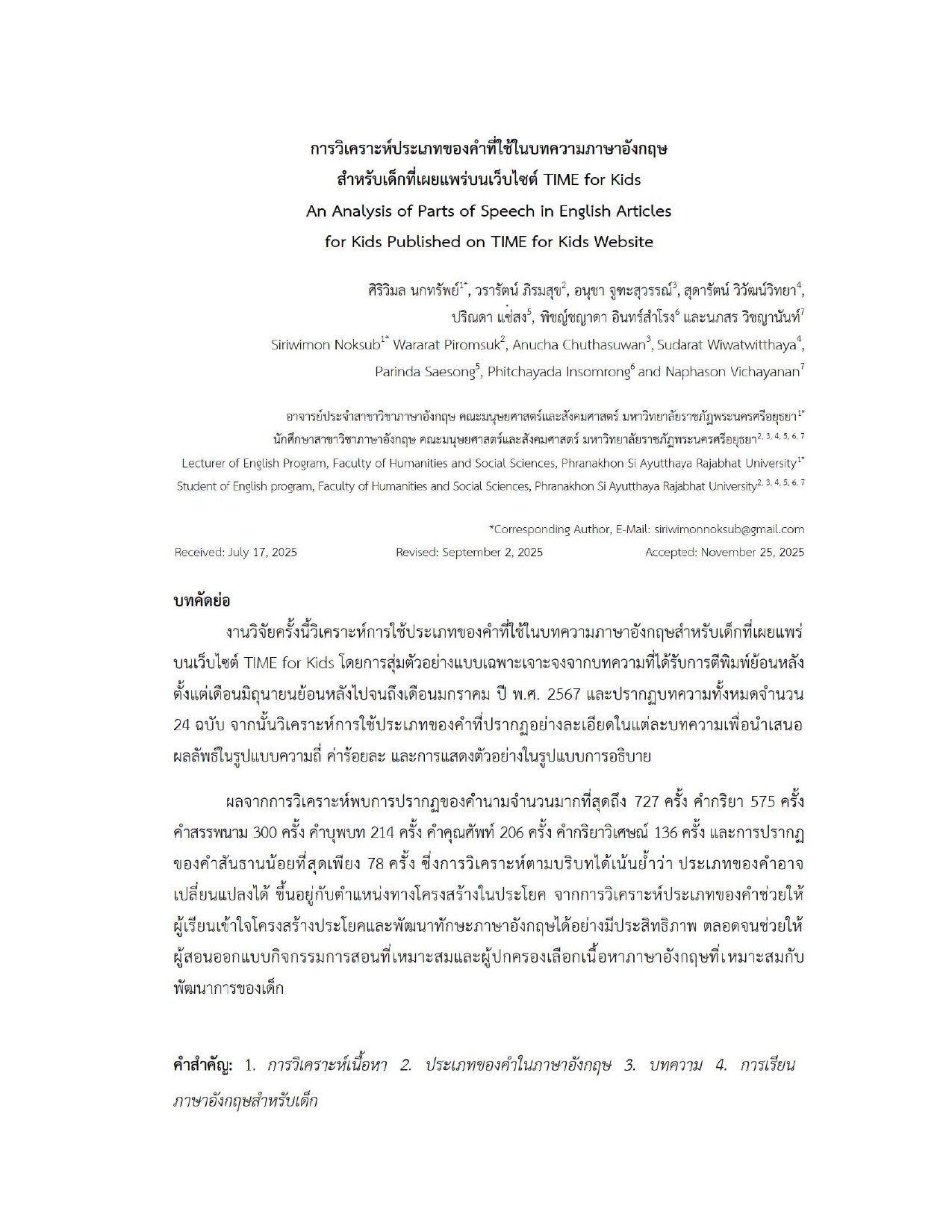
การวิเคราะห์ประเภทของคำที่ใช้ในบทความภาษาอังกฤษสำหรับเด็กที่เผยแพร่บนเว็บไซต์ TIME for Kids
คำสำคัญ:
การวิเคราะห์เนื้อหา ประเภทของคำในภาษาอังกฤษ บทความ การเรียนภาษาอังกฤษสำหรับเด็กบทคัดย่อ
งานวิจัยครั้งนี้วิเคราะห์การใช้ประเภทของคำที่ใช้ในบทความภาษาอังกฤษสำหรับเด็กที่เผยแพร่บนเว็บไซต์ TIME for Kids โดยการสุ่มตัวอย่างแบบเฉพาะเจาะจงจากบทความที่ได้รับการตีพิมพ์ย้อนหลังตั้งแต่เดือนมิถุนายนย้อนหลังไปจนถึงเดือนมกราคม ปี พ.ศ. 2567 และปรากฏบทความทั้งหมดจำนวน 24 ฉบับ จากนั้นวิเคราะห์การใช้ประเภทของคำที่ปรากฏอย่างละเอียดในแต่ละบทความเพื่อนำเสนอผลลัพธ์ในรูปแบบความถี่ ค่าร้อยละ และการแสดงตัวอย่างในรูปแบบการอธิบาย
ผลจากการวิเคราะห์พบการปรากฏของคำนามจำนวนมากที่สุดถึง 727 ครั้ง คำกริยา 575 ครั้ง คำสรรพนาม 300 ครั้ง คำบุพบท 214 ครั้ง คำคุณศัพท์ 206 ครั้ง คำกริยาวิเศษณ์ 136 ครั้ง และการปรากฏ ของคำสันธานน้อยที่สุดเพียง 78 ครั้ง ซี่งการวิเคราะห์ตามบริบทได้เน้นย้ำว่า ประเภทของคำอาจเปลี่ยนแปลงได้ ขึ้นอยู่กับตำแหน่งทางโครงสร้างในประโยค จากการวิเคราะห์ประเภทของคำช่วยให้ผู้เรียนเข้าใจโครงสร้างประโยคและพัฒนาทักษะภาษาอังกฤษได้อย่างมีประสิทธิภาพ ตลอดจนช่วยให้ผู้สอนออกแบบกิจกรรมการสอนที่เหมาะสมและผู้ปกครองเลือกเนื้อหาภาษาอังกฤษที่เหมาะสมกับพัฒนาการของเด็ก
เอกสารอ้างอิง
ปริวรรต อิ่มสะอาด. (2561). Lecture สรุปเข้มอังกฤษ ม.ต้น. กัมบัตเตะ.
พนิตภิชาญ์ มานอก และ ภัทร์ธีรา เทียนเพิ่มพูน. (2562). การวิเคราะห์ข้อผิดพลาดด้านคำศัพท์ในการเขียนภาษาอังกฤษระดับย่อหน้าของนักศึกษาชั้นปีที่ 1 มหาวิทยาลัยศิลปากร วิทยาเขตสนามจันทร์. มหาวิทยาลัยศิลปากร.
ราชบัณฑิตยสถาน. (2556). พจนานุกรม ฉบับราชบัณฑิตยสถาน พ.ศ. 2554. กรุงเทพฯ: ราชบัณฑิตยสถาน.
สำนักงานคณะกรรมการการศึกษาขั้นพื้นฐาน. (2560). หลักสูตรแกนกลางการศึกษาขั้นพื้นฐานพุทธศักราช 2551 (ฉบับปรับปรุง พ.ศ. 2560). กระทรวงศึกษาธิการ.
สุภาพร ศิริไชย. (2548). วรรณคดีและการสื่อสารภาษาไทย. สำนักพิมพ์มหาวิทยาลัยศรีนครินทรวิโรฒ.
ธณิศร บุญสุข, สรวิชญ์ เภาสมบัติ, ศิริญญา ทับสมบัติ, & วานิต พรสุธารักษ์. (2566). การวิเคราะห์ข้อมูลเชิงคุณภาพเพื่อศึกษาแนวทางการปรับปรุงคู่มือปฏิบัติงาน. สถาบันการบินพลเรือน.
American Academy of Pediatrics. (2016). Media and young minds. Pediatrics, 138(5), e20162591. https://doi.org/10.1542/peds.2016-2591
Anderson, C., & Anderson, J. (2010). The Longman writer's companion (6th ed.). Pearson.
Asdar, A., Hustiana, H., & Ahyadi, A. (2023). Part of speech classification by EFL students: A review about their familiarity. ELS Journal on Interdisciplinary Studies in Humanities, 6(4), 793–801. https://doi.org/10.34050/elsjish.v6i4.32383
Baker, C. (2009). Foundations of bilingual education and bilingualism (4th ed.). Multilingual Matters.
Bridge Education Group. (2021, March 22). How to teach parts of speech: ESL lesson tips and activities. https://bridge.edu/tefl/blog/how-to-teach-parts-of-speech/
Cameron, L. (2001). Teaching languages to young learners. Cambridge University Press.
Collins, P., & McKenna, M. (2011). The development of literacy (2nd ed.). Pearson Education.
Common Sense Media. (2023). Common Sense Census: Inside the 2023 digital lives of teens. Common Sense Media. https://www.commonsensemedia.org
Common Sense Media. (n.d.). Time for Kids website review. Retrieved January 4, 2025, from https://www.commonsensemedia.org/website-reviews/time-for-kids
Demme Learning. (2023, April 5). Syntactic awareness: What is it and why is it important? https://demmelearning.com/blog/syntactic-awareness/
EF Education First. (2023). EF English proficiency index 2023: A ranking of 111 countries and regions by English skills. https://www.ef.com/assetscdn/WIBIwq6RdJvcD9bc8RMd/cefcom-epi-site/reports/2023/ef-epi-2023-english.pdf
Ellis, R. (2003). Task-based language learning and teaching. Oxford University Press. George Mason University Writing Center. (n.d.). Scientific (IMRaD) research reports – Overview. Retrieved October 22, 2025, from https://writingcenter.gmu.edu/writing-resources/imrad/writing-an-imrad-report
Grammarly. (n.d.). Types of writing: Learn about different styles of writing. Retrieved January 4, 2025, from https://www.grammarly.com/blog/writing-techniques/types-of-writing/
Hardach, S. (2020, March 3). What’s the best age to learn a language? BBC Future. https://www.bbc.com/future/article/20200303-whats-the-best-age-to-learn-a-language
Harmer, J. (2015). The practice of English language teaching (5th ed.). Pearson Education.
Hyland, K. (2004). Disciplinary discourses: Social interactions in academic writing. University of Michigan Press.
Indeed Editorial Team. (2025, June 6). What is academic writing? Definition and 7 types to consider. Indeed. https://www.indeed.com/career-advice/career- development/academic-writing
Krippendorff, K. (2019). Content analysis: An introduction to its methodology (4th ed.). SAGE Publications.
Lannon, J. M. (2004). Technical writing (8th ed.). Pearson.
Lenneberg, E. H. (1967). Biological foundations of language. Wiley.
Lowth, R. (1762). A short introduction to English grammar. J. Hughs.
Montgomery, O. (2023, January 12). What age is best for learning a language? Red House Academy. https://redhouseacademy.org/วัยใดที่เหมาะกับการเรียนภาษามากที่สุด
Patel, M., Solly, M., & Copeland, S. (2023). The future of English: Global perspectives. British Council. https://www.britishcouncil.org
Pushkina, A., & Krivoshlykova, L. (2020). Ways of teaching functional parts of speech to young learners. In EDULEARN20 proceedings (pp. 6361–6365). https://doi.org/10.21125/edulearn.2020.1686
Quirk, R., Greenbaum, S., Leech, G., & Svartvik, J. (1985). A comprehensive grammar of the English language. London: Longman.
Ramadhani, S., & Ovilia, R. (2022). Understanding parts of speech by EFL students to ease them in constructing an English sentence. Journal of English Language Teaching, 11(4), 359–368. https://doi.org/10.24036/jelt.v11i4.119944
Richards, J. C., & Schmidt, R. (2010). Longman dictionary of language teaching and applied linguistics (4th ed.). Pearson Education Limited.
Saengboon, S., Kosin, P., & Toomaneejinda, A. (2022). The roles of grammar in English language teaching: Local viewpoints. PASAA: Journal of Language Teaching and Learning in Thailand, 63(1), 179–204. https://digital.car.chula.ac.th/pasaa/vol63/iss1/7
Schreier, M. (2012). Qualitative content analysis in practice. SAGE.
Scrivener, J. (2011). Learning teaching: The essential guide to English language teaching (3rd ed.). Macmillan Education.
Silverman, D. (2013). Doing qualitative research (4th ed.). SAGE.
Swan, M. (2005). Practical English usage (3rd ed.). Oxford University Press.
Swan, M., & Walter, C. (1997). How English works: A grammar practice book. Oxford University Press.
Willingham, D. T. (2009). Why don't students like school? Because the mind is not designed for schoolwork. Jossey-Bass.
ดาวน์โหลด
เผยแพร่แล้ว
รูปแบบการอ้างอิง
ฉบับ
ประเภทบทความ
สัญญาอนุญาต
ลิขสิทธิ์ (c) 2026 วารสารวิชาการมนุษยศาสตร์และสังคมศาสตร์ มหาวิทยาลัยราชภัฏนครปฐม

อนุญาตภายใต้เงื่อนไข Creative Commons Attribution-NonCommercial-NoDerivatives 4.0 International License.
วารสารวิชาการมนุษยศาสตร์และสังคมศาสตร์ มหาวิทยาลัยราชภัฏนครปฐม



