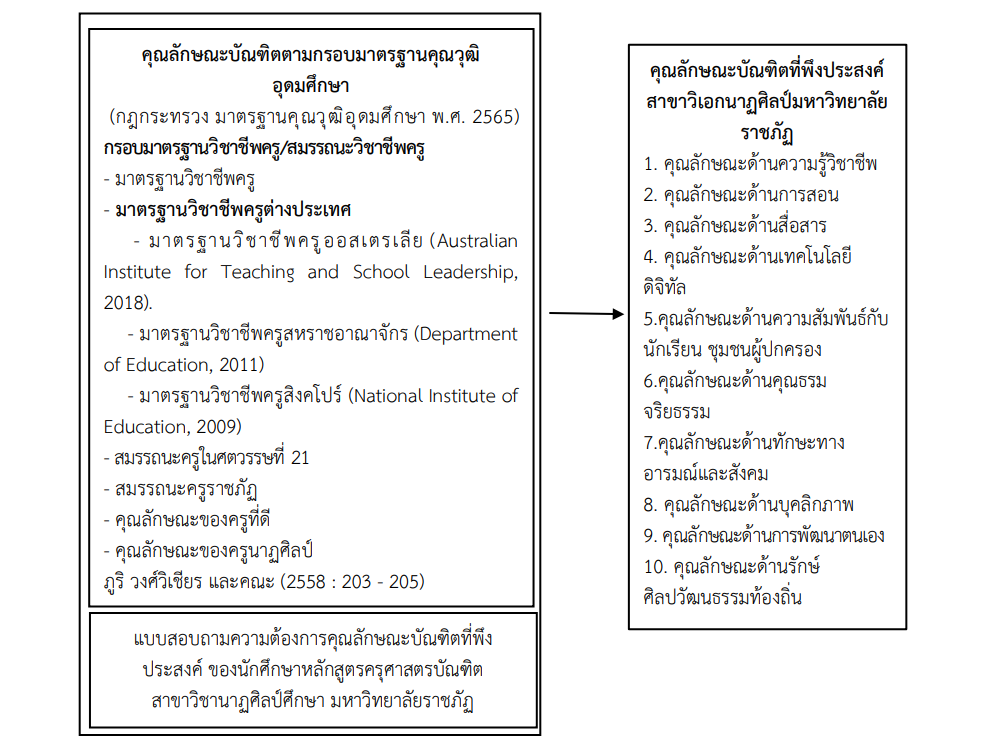
Desired Attributes of Graduate in the Thai Dance Education Major, Rajabhat University
Abstract
This study aims to explore the desirable graduate attributes and determine strategies for their development among Performing Arts Education graduates at Rajabhat University. The research employs a Mixed Method approach, using purposive sampling to select the sample groups, which include 12 administrators, 47 faculty members, 288 Thai dance teachers, 288 fourth- and fifth-year student teachers undergoing professional training, 317 alumni, and 86 employers. The research tools consist of questionnaires and interviews validated by the experts. Data were analyzed using basic statistics such as mean and standard deviation and content analysis derived from open-ended responses and expert interviews. Responses were categorized and synthesized into new narrative summaries. The results indicate that the overall demand for desirable graduate attributes in the ideal condition has a mean score of ( = 4.61), rated at the highest level. When ranked in order of importance, the findings show the following attributes: 1) Ethics and Morality: Achieved the highest mean score of (
= 4.76) rated at the highest level. 2) Personality: Mean score of (
= 4.73), rated at the highest level. 3) Emotional and Social Skills: Mean score of (
= 4.72), rated at the highest level. 4) Self-Development: Mean score of (
= 4.67), rated at the highest level. 5) Preservation of Arts and Local Culture: Mean score of (
= 4.66), rated at the highest level. 6) Communication Skills: Mean score of (
= 4.60), rated at the highest level. 7) Teaching Ability: Mean score of (
= 4.53), rated at the highest level. Stakeholders such as employers, teachers, alumni, administrators, and faculty members suggest the following strategies: Enhancing entrepreneurial skills. Expanding the curriculum to include music and arts-related courses. Promoting skills in integrating Thai dance with other subjects. Engaging experts with knowledge in both traditional Thai and international performing arts. Selecting talented youths with skills in performing arts and providing them with scholarships.
Downloads
Article Details
How to Cite
Section
Research Articles
Copyright & License
Copyright (c) 2025 Arts and Culture Journal of the Lower Moon River

This work is licensed under a Creative Commons Attribution-NonCommercial-NoDerivatives 4.0 International License.
All articles published open access under the CC BY-NC-ND 4.0 license will be immediately and permanently free for everyone to read, download, copy, distribute, print, search, or link to articles free of charge. Use of the articles is permitted for non-commercial purposes only and without modifications. Access does not require prior permission from the publisher or the author, provided that the original publication is appropriately and adequately cited.




References
กระทรวงอุดมศึกษา วิทยาศาสตร์ วิจัยและนวัตกรรม. (2566). แผนปฏิบัติการเชิงยุทธศาสตร์มหาวิทยาลัยราชภัฏ ระยะ 5 ปี (พ.ศ. 2566 - 2570). สำนักงานสภานโยบายการอุดมศึกษา วิทยาศาสตร์ วิจัย และนวัตกรรมแห่งชาติ.
ข้อบังคับคุรุสภาว่าด้วยมาตรฐานวิชาชีพ (ฉบับที่ 4) พ.ศ. 2562 (2562, 20 มีนาคม). ราชกิจจานุเบกษา. เล่ม 136 ตอนพิเศษ 68 ง, 18.
นิวัตต์ น้อยมณี, กัญภร เอี่ยมพญา, อภิชาติ อนุกูลเวช,ดาวประกาย ระโส, และ กนกวรรณ โกนาคม. (2565). แนวทางการพัฒนาคุณลักษณะของครูที่พึงประสงค์สอดคล้องกับสภาวการณ์ตามกฎหมายว่าด้วยการศึกษาชาติ. วารสารสิรินธรปริทรรศน์, 23(1), 103 – 116.
บุญชุม ศรีสะอาด. (2560). การวิจัยเบื้องต้น (พิมพ์ครั้งที่ 10). สุวีริยาสาส์น.
ฝ่ายข่าวหน้า1. (2566). ดัชนีครูไทย ปี2565 “พลังครูคือ หัวใจของการพลิกโฉมคุณภาพการศึกษา”. https://dusitpoll.dusit.ac.th/UPLOAD_FILES/POLL/2566/PS-2566-1673749811.pdf.
พระราชบัญญัติการศึกษาแห่งชาติ (ฉบับที่ 2) พ.ศ. 2545 (2545, 19 ธันวาคม). ราชกิจจานุเบกษา. เล่ม 119 ตอนที่ 123 ก, 16.
พระราชบัญญัติการศึกษาแห่งชาติ พ.ศ. 2542 (2542, 19 สิงหาคม). ราชกิจจานุเบกษา. เล่ม 116 ตอนที่ 74 ก, 1.
ภูริ วงศ์วิเชียร, สุนทรา โตบัว, และ ศุภชัย จันทร์สุวรรณ์. (2558). อนาคตภาพของคุณลักษณะบัณฑิตวิชาชีพครู สาขานาฏศิลป์ไทย ในทศวรรษหน้า (พ.ศ. 2560 – 2569). Veridian E-Journal, Silpakorn University สาขามนุษยศาสตร์ สังคมศาสตร์และศิลปะ, 8(2), 613–627.
มาตรฐานคุณวุฒิระดับปริญญาตรี สาขาครุศาสตร์และสาขาศึกษาศาสตร์ (หลักสูตร 4 ปี) พ.ศ. 2562 (2562, 6 มีนาคม). ราชกิจจานุเบกษา. เล่ม 136 ตอนพิเศษ 56 ง, 12.
มารยาท โยทองยศ และ ปราณี สวัสดิสรรพ์. (ม.ป.ป). การกำหนดขนาดของกลุ่มตัวอย่างเพื่อการวิจัย. http://dspace.nstru.ac.th:8080/dspace/bitstream/123456789/1580/3/เอกสารหมายเลข2.pdf.
วราภรณ์ ศรีอยุธย์. (2565). การสร้างเสริมคุณลักษณะความเป็นครูของนักศึกษา สาขาวิชาการประถมศึกษา คณะครุศาสตร์ มหาวิทยาลัยราชภัฏบ้านสมเด็จเจ้าพระยา. วารสารสถาบันวิจัยญาณสังวร, 13(1), 71 – 82.
สำนักงานคณะกรรมการการศึกษาขั้นพื้นฐาน. (2553). คู่มือประเมินสมรรถนะครูสำนักงานคณะกรรมการการศึกษาขั้นพื้นฐาน พ.ศ. 2553. สำนักงานคณะกรรมการการศึกษาขั้นพื้นฐาน กระทรวงศึกษาธิการ.
Australian Institute for Teaching and School Leadership. (2018). Australian Professional Standards for Teachers. https://www.aitsl.edu.au/docs/default-source/national-policy-framework/australian-professional-standards-for-teachers.pdf.
Department of Education. (2011). Teachers’ Standards. https://assets.publishing.service.gov.uk/media/5a750668ed915d3c7d529cad/Teachers_standard_information.pdf.
Dewi, A. E. R., Kalil, N. C., Hidayat, H., & Juniati, S. R. (2024). Exploring the Relationship between Teacher Professional Development and Student Learning Outcomes. Journal of Pedagogi, 1(5), 109 – 116. https://doi.org/10.62872/a5xyk576.
National Institute of Education. (2009). A Teacher Education Model for the 21st Century. https://singteach.nie.edu.sg/wp-content/uploads/TE21-online-version.pdf.
