The Creative Musical Composition : “Nine Decades of The College of Dramatic Arts”
Abstract
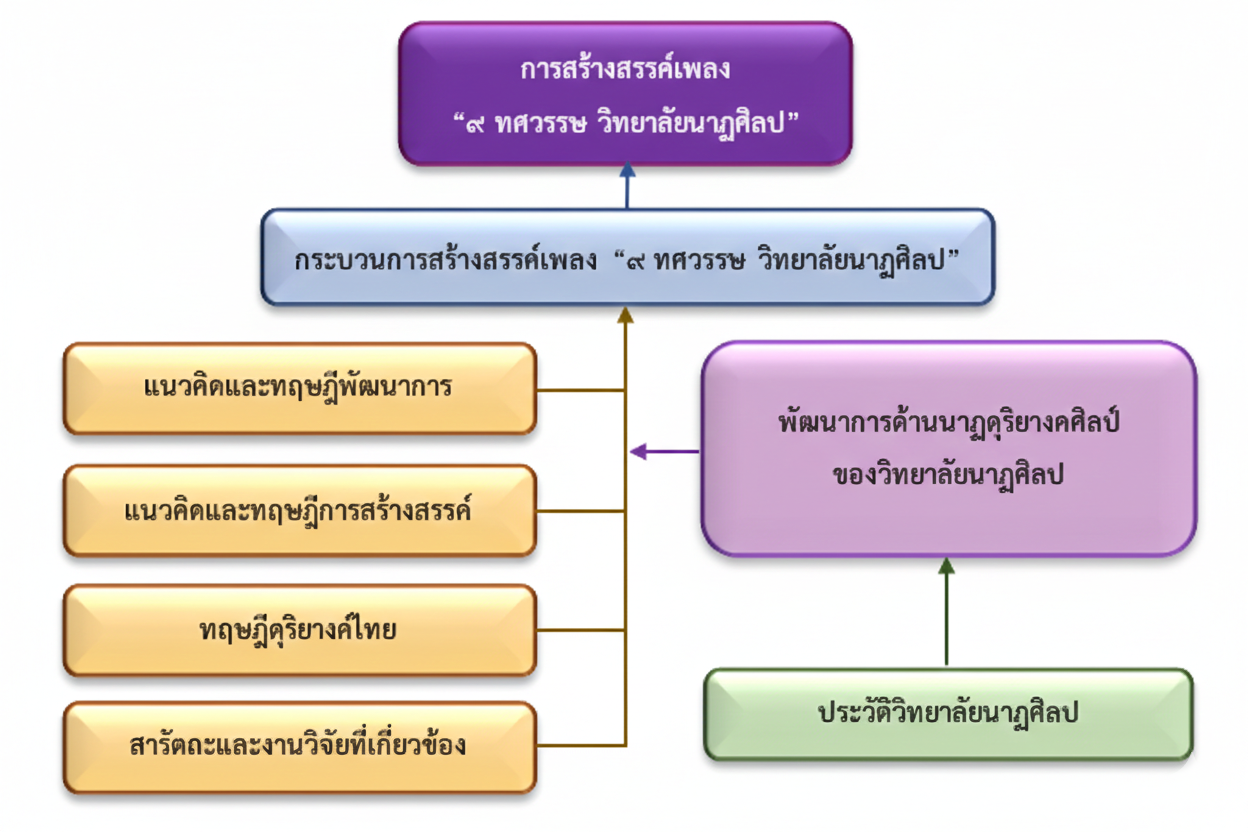
The research titled The Creative Musical Composition: “Nine Decades of The College of Dramatic Arts” aimed to create new lyrics and melodies to convey the history and development of the College of Dramatic Arts. The researcher gathered data from documents and interviews to compose lyrics and created melodies based on Montri Tramote’s Thai music composition principles and Associate Professor Dr. Narongchai Pidokrat’s creative arts theory.
The result found that the creative song devided into three parts: Part 1. “Asirawat Puchaniyasathan” is a Na Phat song (sacred song) composed in a 3-level rhythmic cycle (Sam-Chan). The structure consists of 9 Mai Doen, connecting to Mai La and ended with Pleng Rua to worship the College's sacred objects. Part 2. “Tamnan Kan Wang Na Suep Rakthan” is a song in a 2-level rhythmic cycle (Song-Chan) with lyrics and melodies reflecting a historical atmosphere. It narrates the story from the establishment of the School of Dramatic and Musical Arts and overcomes obstacles to the elevation of Bunditpatanasilpa Institute at present. Part 3. “Chak Wiman Wang Na Su Salaya Kasemsan” conveys the emotions of relocating. The melody begins with sorrow to reminisce about “Wang Na” (the Front Palace) and shifts to a lively, celebratory rhythm to mark the prosperity at “Salaya”. The musical ensemble used for the performance is a Piphat ensemble with western music instruments to appropriately expresses the emotions corresponding to the content of each song.
Downloads
Article Details
How to Cite
Section
Research Articles
Copyright & License
Copyright (c) 2026 Arts and Culture Journal of the Lower Moon River

This work is licensed under a Creative Commons Attribution-NonCommercial-NoDerivatives 4.0 International License.
All articles published open access under the CC BY-NC-ND 4.0 license will be immediately and permanently free for everyone to read, download, copy, distribute, print, search, or link to articles free of charge. Use of the articles is permitted for non-commercial purposes only and without modifications. Access does not require prior permission from the publisher or the author, provided that the original publication is appropriately and adequately cited.




References
เฉลิมศักดิ์ พิกุลศรี. (2530). สังคีตนิยมว่าด้วยดนตรีไทย. โอ.เอส.พริ้นติ้ง เฮ้าส์.
เดชน์ คงอิ่ม. (2564). วิเคราะห์และประพันธ์เพลงไทย. แดเน็กซ์ อินเตอร์คอร์ปอเรชั่น.
เดชน์ คงอิ่ม. (2566). ดุริยพาทยาภิรมย์ ชุด ทศเทพอภิวันทนา. [วิทยานิพนธ์ปริญญาดุษฎีบัณฑิต, สถาบันบัณฑิตพัฒนศิลป์]. Bunditpatanasilpa Institute E-LIBRARY. https://elibrary.bpi.ac.th/book-detail/53283.
ณรงค์ชัย ปิฎกรัชต์. (2563). ทฤษฎีเพื่อการวิจัยและสารัตถบทดนตรี. นาฏดุริยางค์.
บุญธรรม ตราโมท. (2545). คำบรรยายวิชาดุริยางคศาสตร์ไทย. กรมศิลปากร.
พงษ์ศิลป์ อรุณรัตน์. (2554). ปฐมบทดนตรีไทย. โรงพิมพ์มหาวิทยาลัยศิลปากร.
พิชิต ชัยเสรี. (2557). การประพันธ์เพลงไทย. สำนักพิมพ์แห่งจุฬาลงกรณ์มหาวิทยาลัย.
มนตรี ตราโมท. (2538). ดุริยสาส์น. งานพระราชทานเพลิงศพ นายมนตรี ตราโมท. ธนาคารกสิกรไทย.
รังสรรค์ บัวทอง. (2562). การสร้างสรรค์เพลงกลองอาเซี่ยน. [วิทยานิพนธ์ปริญญาดุษฎีบัณฑิต, จุฬาลงกรณ์มหาวิทยาลัย]. Chula Digital Collections. https://digital.car.chula.ac.th/chulaetd/9723/.
สงัด ภูเขาทอง. (2539). การดนตรีไทยและทางเข้าสู่ดนตรีไทย. เรือนแก้วการพิมพ์.
สถาบันบัณฑิตพัฒนศิลป์. (2558). ปวัติยานุกรม สถาบันบัณฑิตพัฒนศิลป์. นุชาการพิมพ์.
สันติ อุดมศรี. (2563). การสร้างสรรค์ผลงานทางดุริยางคศิลป์ : ตับเรื่องเกาะสีชัง. [วิทยานิพนธ์ปริญญาดุษฎีบัณฑิต, จุฬาลงกรณ์มหาวิทยาลัย]. Chula Digital Collections. https://digital.car.chula.ac.th/chulaetd/3853/.
สิริชัยชาญ ฟักจำรูญ. (2537). 60 ปี วิทยาลัยนาฏศิลป. ประยูรวงศ์พริ้นท์ติ้ง.
สิริชัยชาญ ฟักจำรูญ. (2546). การแบ่งประเภทเพลงไทยในปัจจุบัน. ใน สุกัญญา สุจฉายา (บ.ก.), ดุริยางคศิลป์ไทย (180 – 193). สถาบันไทยศึกษา จุฬาลงกรณ์มหาวิทยาลัย.
หลวงวิจิตรวาทการ. (2478). ใบบันทึกเรื่องเสนอโครงระเบียบการโรงเรียนศิลปากร. กรมศิลปากร.
อัศนีย์ เปลี่ยนศรี (2555). พินิจดนตรีไทย เล่ม 2 ชุด “สารัตถะดนตรีไทย”. พิมพ์สวย.
