The Critical Study of Intercultural Linguistics and Cultural Intelligence on Ethnocentrism : The Paradigm
บทคัดย่อ
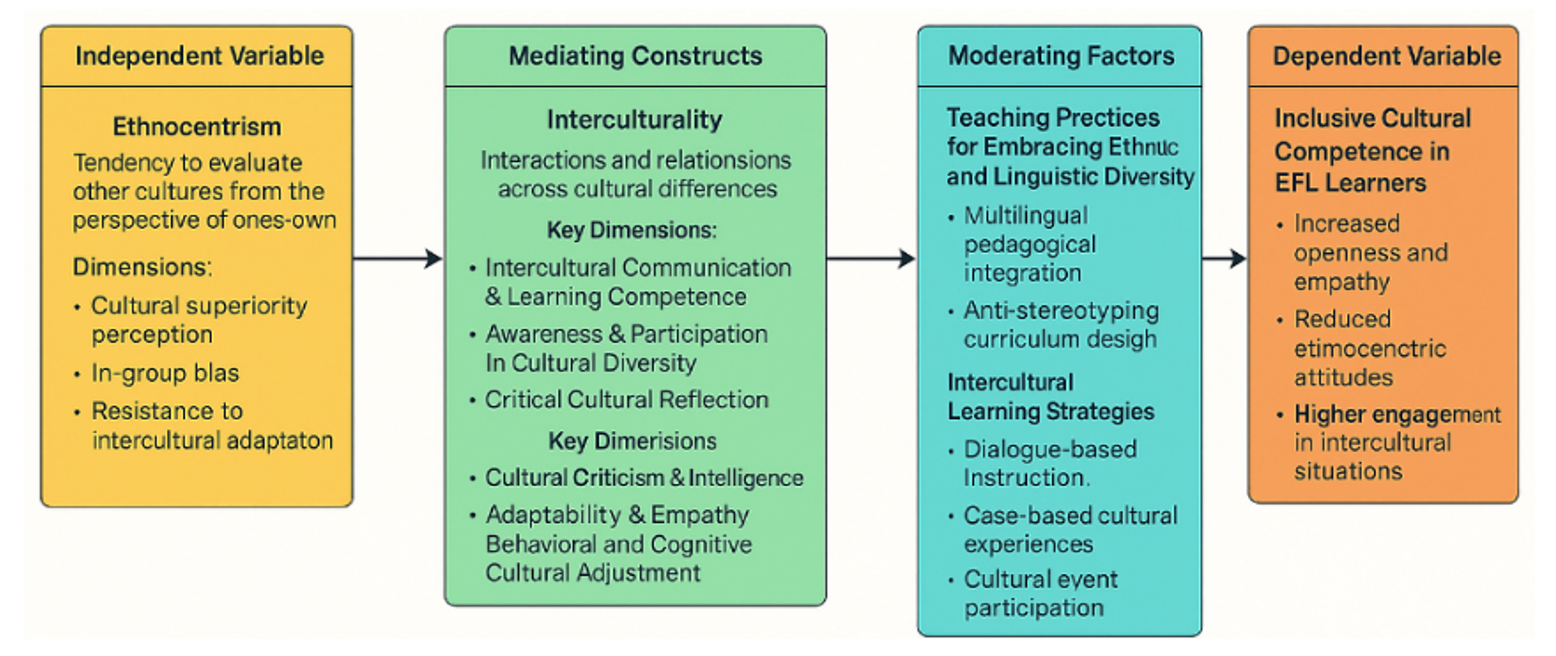
This research examined how ethnocentrism can contribute to the development of interculturality and cultural intelligence among English as a Foreign Language (EFL) students in Thai higher education. The research aims to investigate the ethnocentric factors that drive intercultural linguistics and cultural intelligence development: 1) identify aspects of ethnocentrism that encourage interculturalal linguistics and cultural intelligence, 2) analyze and determine the components of intercultural linguistics and cultural intelligence within ethnocentric contexts, and 3) propose the effects of ethnocentrism on students’ awareness of intercultural linguistics and cultural intelligence. Using mixed methods, the study began with interviews of five intercultural communication experts, followed by data collection from 503 EFL students across six Rajabhat Universities using stratified sampling. Factor analysis revealed two components : cultural diversity navigation skills and intercultural experience-based learning, both showing strong reliability. Results indicated that ethnocentric awareness became more effective when taught through inclusive pedagogy aimed at developing empathy and intercultural competence. The study proposed a framework positioning ethnocentrism as a reflective tool for language education, offering implications for curriculum development and policy formulation.
Downloads
Article Details
รูปแบบการอ้างอิง
ประเภทบทความ
บทความวิจัย
หมวดหมู่
Copyright & License
ลิขสิทธิ์ (c) 2025 วารสารศิลปะและวัฒนธรรมลุ่มแม่น้ำมูล

อนุญาตภายใต้เงื่อนไข Creative Commons Attribution-NonCommercial-NoDerivatives 4.0 International License.
บทความทุกเรื่องที่ตีพิมพ์ในรูปแบบ เปิดให้เข้าถึง (Open Access) ภายใต้สัญญาอนุญาต CC BY-NC-ND 4.0 จะสามารถเข้าถึงได้ฟรีทันทีและอย่างถาวรสำหรับทุกคน โดยผู้อ่านสามารถอ่าน ดาวน์โหลด ทำสำเนา แจกจ่าย พิมพ์ ค้นหา หรือเชื่อมโยงไปยังบทความได้โดยไม่เสียค่าใช้จ่าย การใช้งานอนุญาตเฉพาะเพื่อวัตถุประสงค์ที่ไม่แสวงหากำไร (ไม่อนุญาตการใช้เพื่อการค้า) และต้องไม่ทำการดัดแปลงแก้ไขผลงาน (ไม่อนุญาตการดัดแปลง) การเข้าถึงไม่จำเป็นต้องขออนุญาตล่วงหน้าจากสำนักพิมพ์หรือผู้แต่ง ทั้งนี้ต้องมีการอ้างอิงถึงแหล่งตีพิมพ์ต้นฉบับอย่างถูกต้องและเหมาะสม




เอกสารอ้างอิง
Abdul Malek, M., & Budhwar, P. (2013). Cultural Intelligence as a Predictor of Expatriate Adjustment and Performance in Malaysia. Journal of World Business, 48, 222 - 231. https://doi.org/10.1016/j.jwb.2012.07.006.
Adair, W. L., Hideg, I., & Spence, J. R. (2013). The Culturally Intelligent Team : The Impact of Team Cultural Intelligence and Cultural Heterogeneity on Team Shared Values. Journal of Cross - Cultural Psychology, 44(6), 941 - 962. https://doi.org/10.1177/0022022113492894.
Ang, S., & Inkpen, A. C. (2008). Cultural Intelligence and Offshore Outsourcing Success : A Framework of Firm - Level Intercultural Capability. Decision Sciences, 39(3), 337 - 358. https://doi.org/10.1111/j.1540-5915.2008.00195.x.
Ang, S., & Van Dyne, L. (2008a). Conceptualization of Cultural Intelligence : Definition, Distinctiveness, and Nomological Network. Routledge.
Ang, S., & Van Dyne, L. (2008b). Handbook of Cultural Intelligence : Theory, Measurement and Application. Routledge.
Arasaratnam, L. A. (2012). Intercultural Spaces and Communication within : An Explication. Australian Bentler, P. M., & Chou, C. P. (1987). Practical Issues in Structural Modeling. Sociological Methods & Research, 16(1), 78 - 117. https://doi.org/10.1177/0049124187016001004.
Bizumic, B. (2014). Who Coined the Concept of Ethnocentrism? A Brief Report. Journal of Social and Political Psychology, 2(1), 3 - 10. https://doi.org/10.5964/jspp.v2i1.264.
Byram, M. (1997). Teaching and Assessing Intercultural Communicative Competence. Multilingual Matters.
Deardorff, D. K. (2006). Identification and Assessment of Intercultural Competence as a Student Outcome of Internationalization. Journal of Studies in International Education, 10, 241 - 266. https://doi.org/10.1177/1028315306287002.
Dervin, F. (2011). A Plea for Change in Research on Intercultural Discourses : A ‘Liquid’ Approach to the Study of the Acculturation of Chinese Students. Journal of Multicultural Discourses, 6(1), 37 - 52. https://doi.org/10.1080/17447143.2010.532218.
Du, W. H. (2008). Integrating Culture Learning into Foreign Language Curricula : An Examination of the Ethnographic Interview Approach in a Chinese as a Foreign Language Classroom [Unpublished Doctoral dissertation]. University of Wisconsin - Milwaukee.
Earley, P. C., & Ang, S. (2003). Cultural Intelligence : Individual Interactions Across Cultures. Stanford University Press.
Earley, P. C., & Peterson, R. S. (2004). The Elusive Cultural Chameleon : Cultural Intelligence as a New Approach to Intercultural Training for the Global Manager. Academy of Management Learning & Education, 3(1), 100 - 115. https://doi.org/10.5465/amle.2004.12436826.
Fuentes, A. (2022). Evolving Belief, Evolving Minds : Evolutionary Insights into the Development and Functioning of Human Society. Frontiers in Behavioral Neuroscience, 16. https://doi.org/10.3389/fnbeh.2022.928297.
Gorski, P. C. (2008). Good Intentions are Not Enough : A Decolonizing Intercultural Education. Intercultural Education, 19(6), 515 - 525. https://doi.org/10.1080/14675980802568319.
Hancı-Azizoglu, E. B., & Alawdat, M. (2021). Rhetoric and Sociolinguistics in Times of Global Crisis. IGI
Higgen, S., & Mösko, M. (2020). Mental Health and Cultural and Linguistic Diversity as Challenges in School? An Interview Study on the Implications for Students and Teachers. PLOS ONE, 15(7), e0236160. https://doi.org/10.1371/journal.pone.0236160.
Hofstede, G. (1984). Culture’s Consequences : International Differences in Work-Related Values. Sage.
Hofstede, G. (2001). Culture’s Consequences : Comparing Values, Behaviors, Institutions and Organizations across Nations. Sage.
Holliday, A. (1999). Small Cultures. Applied Linguistics, 20(2), 237 - 264. https://doi.org/10.1093/applin/20.2.237.
Khan, K. Z., Hasan, K., Ali, A., & Arif, M. I. (2020). Measuring the Effects of Emotional Intelligence, Leaders (3rd ed.). Corwin Press.
Lee, J., Crawford, A., Weber, M. R., & Dennison, D. (2018). Antecedents of Cultural Intelligence Among American Hospitality Students : Moderating Effect of Ethnocentrism. Journal of Hospitality & Tourism Education, 30(3), 167 - 183. https://doi.org/10.1080/10963758.2018.1444494.
Lin, C. (2020). Understanding Cultural Diversity and Diverse Identities. In Leal Filho, W., Azul, A. M., Brandli, L., Özuyar, P. G., & Wall, T. (Eds.), Quality Education (929 - 938). Springer International Publishing. https://doi.org/10.1007/978-3-319-95870-5_37.
Lindsey, R. B., Roberts, L. M., & Campbell-Jones, F. L. (2013). The Culturally Proficient School : An Implementation Guide for School Leaders (2nd ed.). Corwin Press.
Lindsey, R. B., Robins, K. N., & Terrell, R. D. (2009). Cultural Proficiency : A Manual for School Leaders (3rd ed). Corwin Press.
Ramírez-Verdugo, M. D., & Márquez, E. (2022). A Sociocultural Study on English Learners’ Critical Thinking Skills and Competence: In Information Resources Management Association (Eds.), Research Anthology on Applied Linguistics and Language Practices (1237 - 1257). IGI Global. https://doi.org/10.4018/978-1-6684-5682-8.ch058.
Risager, K. (2006). Language and Culture : Global Flows and Local Complexity. Multilingual Matters.
Semenov, A. (2022). An Analysis of Aleksandar Vučić’s 2019 National Assembly Speech. Journal of Contemporary Central and Eastern Europe, 30(2), 259 - 272. https://doi.org/10.1080/25739638.2022.2092260.
Trompenaars, F., & Hampden-Turner, C. (1997). Riding the Waves of Culture (2nd ed.). Nicholas Brealey.
Yunlu, D. G., Clapp-Smith, R., & Shaffer, M. (2017). Understanding the Role of Cultural Intelligence in Individual Creativity. Creativity Research Journal, 29(3), 236 - 243. https://doi.org/10.1080/10400419.2017.1360070.
