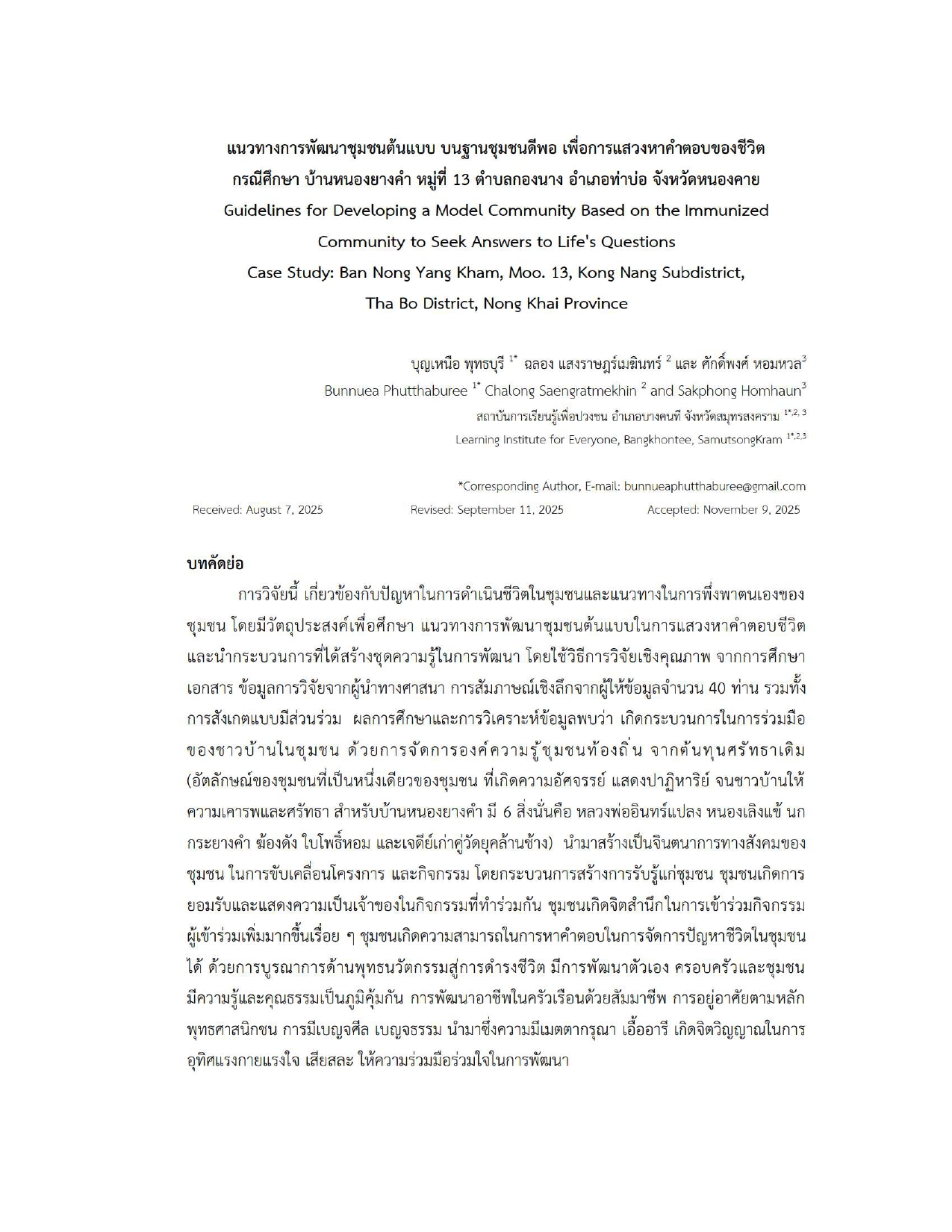
Guidelines for Developing a Model Community Based on the Immunized Community to Seek Answers to Life's Questions Case Study: Ban Nong Yang Kham, Moo. 13, Kong Nang Subdistrict, Tha Bo District, Nong Khai Province
Keywords:
Social geography , seeking answers in life, the immunized communityAbstract
This research addresses community life issues and approaches to community self-reliance. The objectives were to study community development approaches for finding answers to life's problems and to apply the knowledge-building process to development. Using qualitative research methods. This research examined documents, research data from religious leaders, in-depth interviews with 40 informants, and participant observation. The results of the study and data analysis revealed a collaborative process among community members, using local community knowledge management. This process leveraged the community's original beliefs (the unique community identity, which miraculously manifests itself, earning villagers respect and faith. For Ban Nong Yang Kham, these six items are Luang Por Inplang, Nong Leang Khae, the Golden Heron, the famous gong, the fragrant Bodhi leaf, and the ancient pagodas of the Lan Xang era temples). This was used to create the community's social imagination, driving projects and activities. Through community awareness-raising, the community gained acceptance and ownership of their shared activities, fostering a sense of participation and increasing participation. The community developed the ability to find solutions to community life problems through the integration of Buddhist innovation into livelihoods, fostering self-development, family, and community development, fostering knowledge and morality as immunity, and developing household careers through right livelihoods. Living according to Buddhist principles, observing the Five Precepts and Five Virtues fosters compassion, kindness, and a spirit of dedication, sacrifice, and cooperation. A key factor in seeking answers is building a spiritual foundation. Wat Champa Thong serves as a center for learning and development. Its leaders, monks, serve as the source of knowledge transfer for the local community. They lead the collection and creation of a community monitoring system, allowing everyone to inquire about community development, local wisdom, and traditions. This is the foundation of faith. Integrating the 27 principles of work of King Rama IX with the teachings of the Buddha promotes rapid development and enables the search for answers to all life's problems. Therefore, Ban Nong Yang Kham is well-positioned to serve as a center for local community development. It is well-positioned to work collaboratively with the community, preserve traditions, and culture for future generations. It is well-positioned to understand the community's natural resources, and foster excellent relationships with people, culture, traditions, and resources within the community.
References
ตรีทิพย์นภา ทองดี. (2568). แนวทางการพัฒนาคุณธรรมจริยธรรมสำหรับเยาวชนไทยในศตวรรษที่ 21. วารสารสื่อวิชาการและวิจัย, 1(2), 33-42. https://so12.tci-thaijo.org/index.php/JERR/issue/view/271
นิคม ปาทะวงศ์, จำรัส บุดดาพงษ์, และวิพจน์ วันคำ. (2564). การสืบสานและการสร้างคุณค่าประเพณีจุดไฟตูมกา จังหวัดยโสธร. วารสารสังคมศาสตร์และมานุษยวิทยาเชิงพุทธ, 6(12), 153-167. https://so04.tci-thaijo.org/index.php/JSBA/issue/view/16810
พระครูใบฎีกา ทวีศักดิ์ ใต้ศรีโคตร, และพระมหาสราวุธ โพธิ์ศรีขาม. (2567). พระพุทธศาสนา กับการพัฒนาทุน มนุษย์และสังคม. วารสารธรรมเพื่อชีวิต, 30(4), 279-287. https://so06.tci-thaijo.org/index.php/jmb/article/view/261662
พระครูปริยัติ สุวรรณวัฒน์. (2568, 20 มกราคม). เจ้าอาวาสวัดจำปาทอง อำเภอท่าบ่อ จังหวัดหนองคาย. [สัมภาษณ์]
พระครูปริยัติ สุวรรณวัฒน์, อริย์ธัช เลิศรวมโชค, ทองคำ ดวงขันเพ็ชร, ภัณฑิลา น้อยเจริญ, และศุภ-กิจ ภักดีแสน. (2565). รูปแบบการพัฒนาชุมชนสร้างสรรค์ ด้วยกระบวนการเทคโนโลยีสิ่งแวดล้อม และการออกแบบ จังหวัดหนองคาย. วารสาร มจร.อุบลปริทรรศน์, 7(2), 2387-2400. https://so06.tci-thaijo.org/index.php/mcjou/article/view/259914
พระมหาปรีชา รตนโชโต (ไชย อยู่), สมเดช นามเกตุ, พระครูจิรธรรมธัช ธรรมธัช, และอริย์ธัช เลิศ รวมโชค. (2567). กระบวนการสร้างจิตสำนึกเชิงพุทธในการจัดการป่าชุมชนต้นแบบ อำเภอกู่แก้ว จังหวัดอุดรธานี. วารสารพุทธศาสตร์ มจร. อุบลราชธานี, 6(3), 1787-1798. https://so12.tci-thaijo.org/index.php/JOBU2025/article/view/3469
ยโสธารา ศิริภาประภากร, จำนงค์ จันทร์เขียว, และสุริยา คลังฤทธิ์. (2568). วัดพัฒนากับมิติใหม่ ของแหล่งท่องเที่ยวเชิงศาสนา: การมีส่วนร่วมของพระเกจิอาจารย์ ในการเสริมสร้างคุณค่าทางจิตวิญญาณ และเศรษฐกิจชุมชน กรณีวัดป่าอาเจียง ตำบลกระโพ อำเภอท่าตูม จังหวัดสุรินทร์. วารสารพุทธนวัตกรรม การศึกษา, 1(1). 55-70. https://so14.tci-thaijo.org/index.php/jbei/article/view/1720
รชา ถาวระ. (2567). กระบวนการออกแบบอย่างมีส่วนร่วมสำหรับถนนสายวัฒนธรรมคลองกระแชง จ.เพชรบุรี. สาระศาสตร์, 7(3), 580-592. https://so05.tci-thaijo.org/index.php/sarasatr/article/view/273125
ศักดิ์พงศ์ หอมหวล (2568, 20 มกราคม). อธิการบดี สถาบันการเรียนรู้เพื่อปวงชน. [สัมภาษณ์]
สุทธินันท์ หล่อวิไลกุล. (2564). ศีลธรรม ที่เริ่มหายไปจากความเป็นพลเมืองของไทย. วารสารสันติสุขปริทรรศน์, 2(2). 45-58. https://so09.tci-thaijo.org/index.php/JPP/issue/view/17
อาทิตย์ ซาวคำ, รณชิต อภัยวาทิน, และนิพิฐพนธ์ นันทะวงศ์. (2568). แนวทางการส่งเสริมสมรรถนะการทำงานในอนาคต สำหรับผู้เรียนในโลกยุคแห่งนวัตกรรม. วารสารวิชาการมนุษยศาสตร์และสังคมศาสตร์ มหาวิทยาลัยราชภัฏนครปฐม, 15(2), 125-140. https://so07.tci-thaijo.org/index.php/HUSO-J
Downloads
Published
How to Cite
Issue
Section
License
Copyright (c) 2026 Journal of Humanities and Social Sciences Nakhon Pathom Rajabhat University

This work is licensed under a Creative Commons Attribution-NonCommercial-NoDerivatives 4.0 International License.
Journal of Humanities and Social Sciences Nakhon Pathom Rajabhat University



